How a French Drain Relieves Hydrostatic Pressure
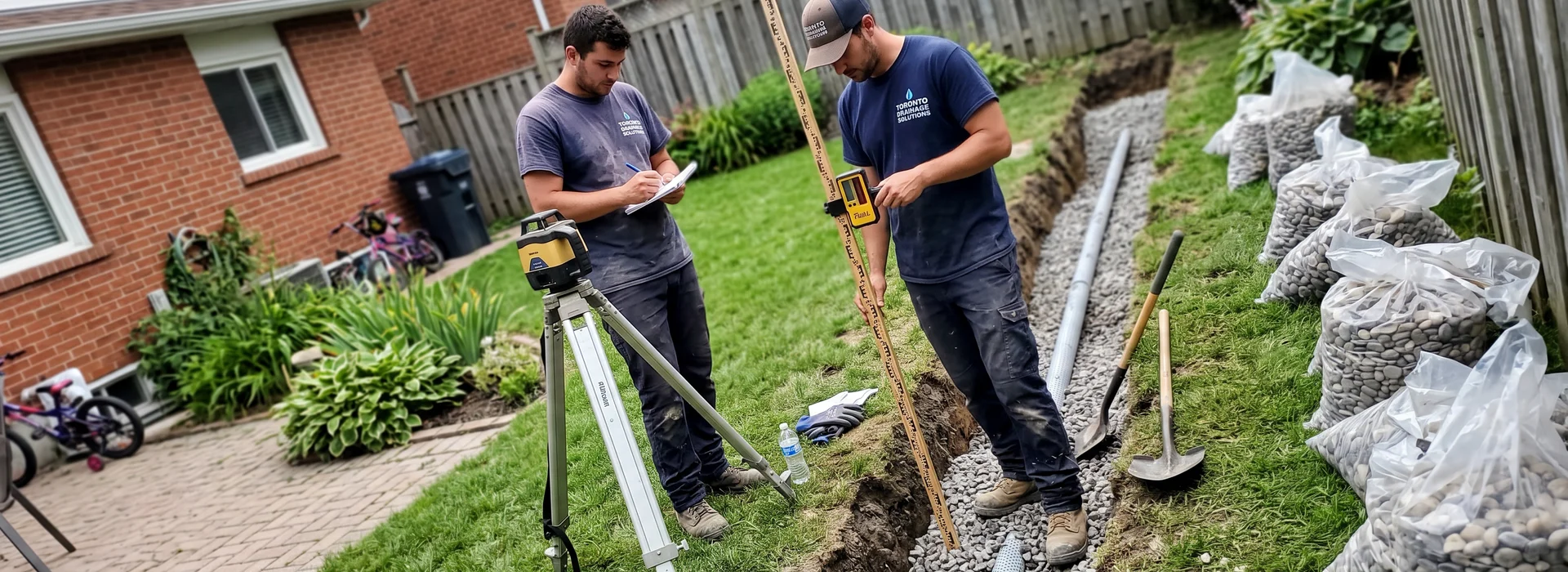
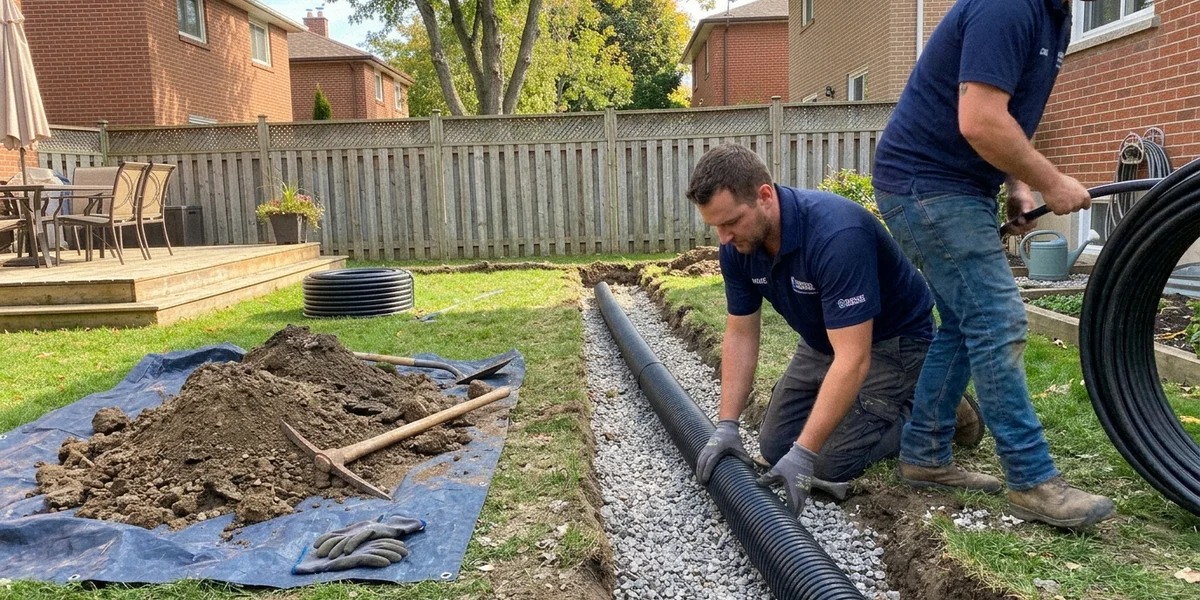
Foundation Waterproofing Toronto has installed French drains and yard drainage across Toronto and the GTA for more than 25 years, as the surface water management half of a foundation waterproofing strategy. A French drain is perforated Big O corrugated drainage tubing laid in a trench of clear drainage gravel aggregate, wrapped in non-woven geotextile fabric, and graded so water flows to a discharge point. Water in the surrounding soil enters the stone, finds the perforations, and leaves along the pipe instead of sitting in the ground.
For a foundation, that matters because of what saturated soil does. Water held in clay next to a basement wall builds hydrostatic pressure, and that pressure is what pushes water through the cove joint and the cracks. Improving soil drainage before the water reaches the wall is hydrostatic relief delivered at the cheapest point in the system, and it is far cheaper than the foundation repair that years of saturated clay eventually cause.
Downspouts and Grading: The Cheapest Load to Remove
Before any interior or exterior basement system, we look at how much water is being delivered to the foundation by the property itself.
A single downspout on a modest Toronto roof discharges thousands of litres during a heavy storm. Dumped at the base of the wall, all of that goes into the soil at the one place you least want it. A downspout disconnect with a proper extension or a tie-in to a drain run removes that load for a few hundred dollars, and the City of Toronto already requires downspouts to be disconnected from the sewer system on most properties.
Yard re-grading does the same for sheet flow. The standard is positive slope away from foundation, roughly 150 mm of fall over the first 1.8 metres. Settled backfill from an old excavation, a neighbour’s raised grade, or twenty years of garden bed topping up will all quietly reverse that slope. On the narrow side yards between semi-detached houses in East York and the older bungalows of Scarborough, reversed grade is the most common surface water fault we find.
These two items together are often the first thing we quote, because on many lots they reduce the basement scope from a system to a repair.
Which Yard Drainage Scope Does Your Toronto Lot Need?
| Scope | Cost in Toronto (2026 pricing) | What it removes |
|---|---|---|
| Downspout disconnect and grading | $400 to $1,800 CAD | Roof discharge and reversed slope, the cheapest load to take off the foundation |
| Single-run French drain | $3,400 to $7,000 CAD | One wet area intercepted on its uphill side and routed to a legal outlet |
| Perimeter yard drainage | $7,000 to $14,000 CAD | Sheet flow around the whole lot, with catch basins at low points and downspout tie-ins |
| Drain plus dry well | $5,000 to $16,000 CAD | Sites with no storm connection or daylight outlet, sized for the catchment |
How We Compare
| What you get | Typical provider | Foundation Waterproofing Toronto |
|---|---|---|
| Pricing | Quoted only after a site visit | $85 to $175 CAD per linear foot published on this page (2026 pricing) |
| Bedding stone | Pea gravel, often with fines | Clear washed stone that keeps its voids open |
| Filter | Unwrapped pipe or no cloth | Non-woven geotextile fabric wrapped over the stone bed |
| Fall | Laid by eye | Designed gradient confirmed with a laser level |
| Discharge | Wherever the trench ends | Storm connection, daylight outlet, or sized dry well, never the sanitary sewer |
| Warranty | Unstated or verbal | Written workmanship warranty issued at completion |
Designing the Run: Route, Depth, Fall and Discharge
When a French drain does not work, the cause is usually the design, not the installation.
Route. The pipe has to intercept water where it travels, which is usually the uphill side of the wet area, not the wet area itself. On the ravine-edge lots of North York and the sloped back yards of Etobicoke, that often means a run across the top of the yard rather than along the house.
Depth. Typically 450 to 900 mm. Deep enough to sit below the water you are collecting, shallow enough that the discharge point can still be lower than the pipe.
Fall. Continuous gradient to the outlet, confirmed with a laser level. A flat section becomes a silt trap and the run behind it backs up.
Discharge. This is the constraint that decides everything else. A storm connection where one exists and is permitted, a daylight outlet at a low point on the lot, or a dry well discharge chamber sized for the catchment. Where none of those is available on a flat lot, the run can end in an exterior sump basin with its own sump pump that lifts the water to a safe outlet at grade. Never the sanitary sewer.
Catch basins. At low points and at downspout tie-ins, with removable baskets so leaf debris is caught where you can reach it instead of inside the pipe.
Before any trench is cut, utility locates are requested through Ontario One Call, because gas, hydro, and cable lines cross most Toronto back yards at shallow depth.
Why Do Cheap French Drains Fail?
The failed drains we are called to replace almost all trace back to three shortcuts.
Pea gravel instead of clear washed stone. Pea gravel contains fines that migrate into the voids and choke the drain within a few seasons.
No filter cloth. Without non-woven geotextile fabric separating stone from soil, silt moves into the stone bed and eventually into the perforations.
No designed fall. A pipe laid by eye across an undulating yard will have low spots, and low spots hold water and sediment.
The material cost difference between doing it properly and doing it cheaply is small. The labour is identical. The lifespan difference is measured in decades.
When Your Basement Needs More Than a Yard Drain
The Foundation Waterproofing Toronto crew turns down yard drainage work regularly, because a French drain only solves water that arrives from the surface.
If basement water appears during the spring thaw regardless of rainfall, the water table under the slab is the driver, and a yard drain at 600 mm depth will never reach it. Interior weeping tile is the correct scope.
If water is entering through a single crack that leaks during every rain, the crack injection at $500 to $1,200 CAD is the proportionate fix.
If the yard drains freely and the grade already runs away from the house, there is nothing for a drain to collect.
The free in-home inspection covers the lot as well as the basement, and the written diagnostic ranks what to do in what order, with the CAD number against each. Often the first line on that list is the cheapest one, which is why surface water work is quoted ahead of any larger foundation waterproofing Toronto system.