How Crack Injection Seals a Foundation Wall
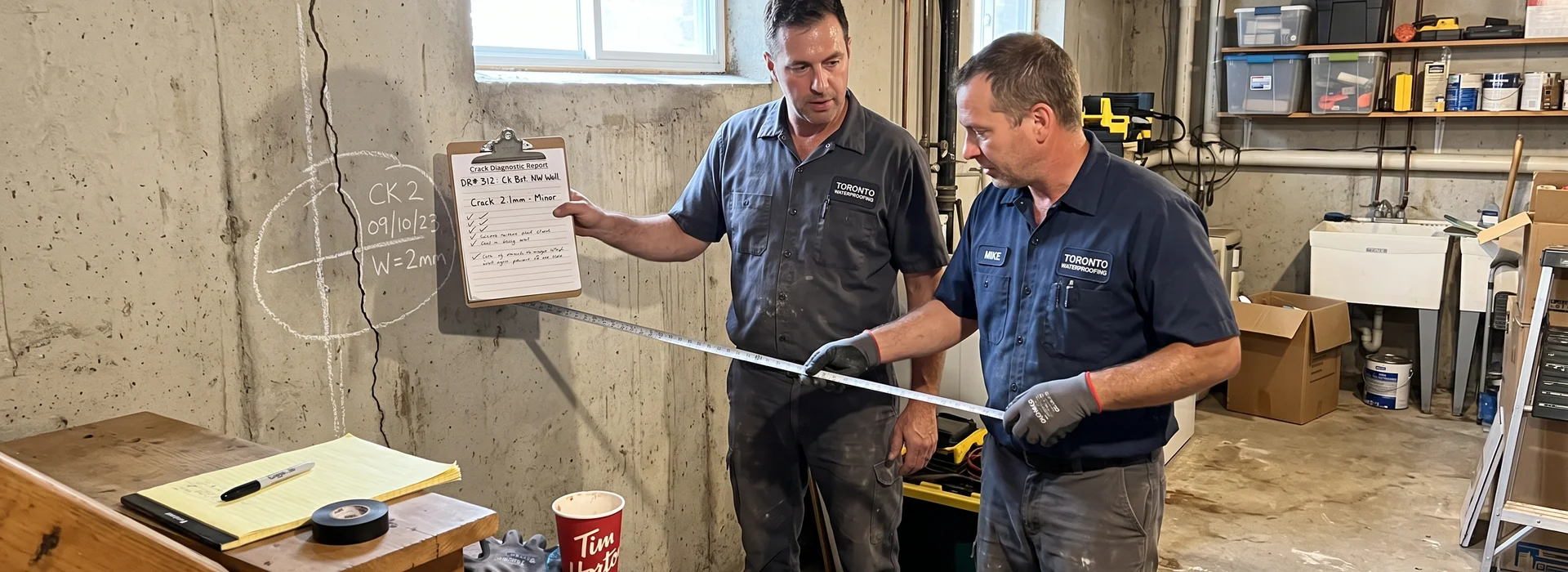
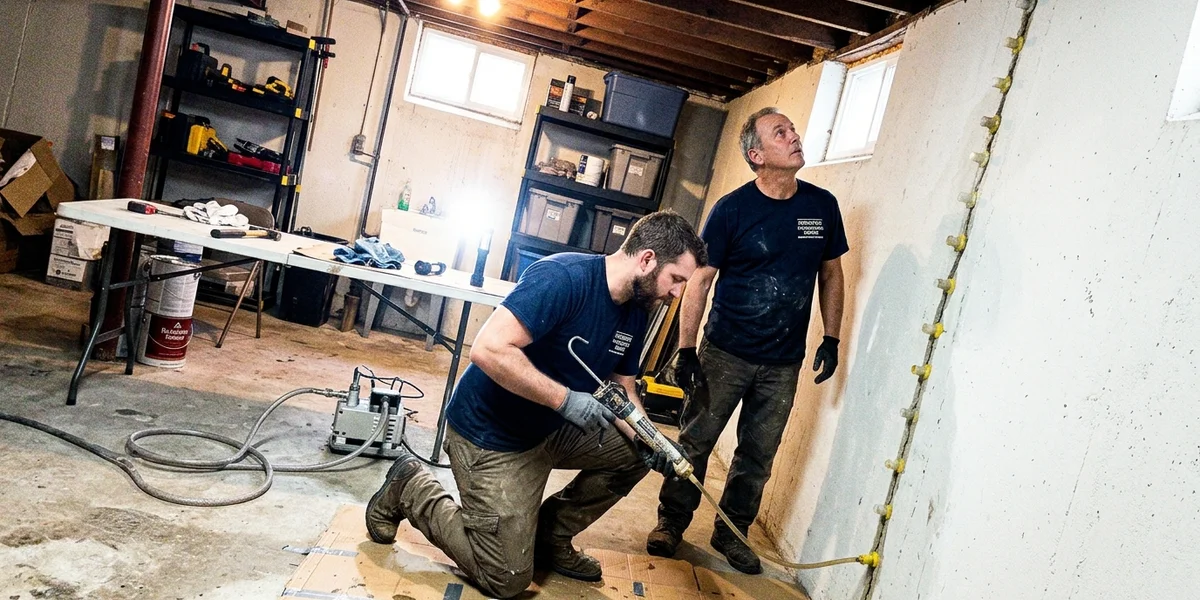
Foundation Waterproofing Toronto repairs leaking cracks in detached, semi-detached, and new-build homes across Toronto and the GTA by filling the entire thickness of the wall, not the face of it. We set injection ports (packers) along the crack at spacing matched to the wall thickness, seal the surface between them with a fast-setting paste, then inject resin at low pressure starting at the lowest port. When resin appears at the port above, that section is full and we move up. The result is a continuous plug through the wall rather than a cosmetic patch.
Two products do two different jobs. Low-pressure polyurethane injection uses a closed-cell resin that expands on contact with moisture and stays flexible afterward, which is what you want in a crack that will see seasonal movement. Structural epoxy resin cures rigid with high tensile strength PSI and bonds the crack faces into one structural section again. Water control gets polyurethane. Load-bearing repair gets epoxy. Using epoxy on a moving crack is how repairs fail.
Crack injection is concrete repair at its most targeted: one crack, one product, one visit. Where the crack is only one of several water entry points, or the weeping tile at the footing has failed, it becomes part of a wider basement waterproofing scope, and the inspection will say so.
How to Read a Crack Before the Inspection
Before the inspection, it helps to know what you are looking at.
- Orientation. Vertical cracks are usually curing shrinkage. Diagonal cracks from an opening corner suggest settlement. Horizontal cracks mean lateral soil load.
- Width. Anything you can fit a business card into is worth measuring properly. Hairline to 1/4 inch is the non-structural range.
- Offset. Run a finger across the crack. If one face sits proud of the other, the wall has moved, and that changes the recommendation.
- Staining. A rust-coloured or white efflorescence trail below the crack confirms water has been moving through it repeatedly.
- Company. A single crack in the middle of a long wall is typical shrinkage. Several parallel cracks, or cracks matched by a crack in the slab, point to a foundation issue.
Polyurethane or Epoxy: Which Injection Does Your Crack Need?
These are 2026 CAD rates and match the price tiers further down the page.
| Product | Cost in Toronto | What it is for |
|---|---|---|
| Low-pressure polyurethane | $500 to $1,200 CAD per crack | Water control in a non-structural crack that will see seasonal movement; stays flexible after curing |
| Structural epoxy | $700 to $1,800 CAD per crack | Load-bearing repair in sound poured concrete; cures rigid and bonds the faces |
| Exterior membrane repair | $2,500 to $6,500 CAD | Where the crack has to be treated from the soil face, with excavation, parging, and membrane |
| Multi-crack package | $1,400 to $3,200 CAD | Two to four cracks treated in one visit, with setup shared across every crack |
Why Poured Concrete Foundations Crack in Toronto Clay
Concrete shrinks as it cures. On a long foundation wall, that shrinkage has to relieve somewhere, and it does so as a vertical crack, usually near a window opening, a form tie line, or an area of concrete honeycombing where the pour was not fully consolidated. That is normal and it happens in the first two years, which is why we see it as often in new subdivisions in Vaughan and Markham as in postwar bungalows in North York and Scarborough.
What makes Toronto different is what happens afterward. The Halton Till clay under much of the city swells when saturated and shrinks when dry, and the freeze-thaw cycle repeats that load dozens of times each winter. A hairline crack that would stay dry in sandy soil becomes a recurring leak here, because the soil is delivering water to the wall under hydrostatic pressure every spring thaw.
When Should a Crack Not Be Injected?
We turn down injection work regularly, and it is worth knowing why.
If the wall shows a horizontal bowing shear crack, the concrete is being pushed inward by soil pressure. Filling the crack does nothing about the load. The correct scope is carbon fibre or steel reinforcement, usually with an engineer’s stamp, which is covered under concrete foundation repair. Diagonal cracks from ongoing footing settlement are also an engineering question first, because the answer may be underpinning rather than any crack product.
If the crack is in a concrete block or masonry wall, common in the 1920s to 1950s houses of East York, the Danforth, and older Etobicoke, water is travelling through hollow cores rather than a single void, and injection cannot chase it. Interior drainage or exterior membrane is the honest fix.
If the crack leaks only when a specific downspout runs, the crack is a symptom. Fixing the discharge and the grade may reduce the load enough that the injection holds for decades rather than seasons.
Exterior Crack Repair: Excavation, Membrane and Parge Coat
Where we do excavate, the process is targeted. We open a trench only at the crack, clean the wall face, repair any spalled concrete, and apply hydraulic cement parging where the surface is irregular so the parge coat gives the membrane a continuous substrate. We then bond an elastomeric membrane such as Blueskin over the repair and fasten Delta-MS drainage board. Backfill goes in lifts and gets tamped. This costs $2,500 to $6,500 CAD and is worth it when the wall above the crack is also failing, or when interior access is blocked by a finished basement you do not want opened.
How We Compare
| What you get | Typical provider | Foundation Waterproofing Toronto |
|---|---|---|
| Pricing | Quoted only after a site visit | $500 to $1,800 CAD per crack published on this page (2026 pricing) |
| Crack triage | Verbal opinion | Orientation, measured width, and offset documented in writing |
| Product choice | One resin for every crack | Polyurethane for water control, structural epoxy for load-bearing repair |
| Warranty | Unstated or verbal | 10-year written workmanship warranty, re-injection at no charge |
| Structural cracks | Injected anyway | Referred to engineering, with City of Toronto permit administration handled |
| Track record | Unstated | 25+ years, WSIB registered, $2M liability insurance |
What You Get in Writing After the Repair
Every crack repair produces a written diagnostic naming the crack type, the measured width, the product used, and the 10-year written workmanship warranty certificate. If the crack was triaged as structural, the file also includes the engineering correspondence and the City of Toronto permit close-out. That paperwork is also what a buyer’s home inspector will ask for when a crack shows up on a pre-purchase report.
If a crack on your wall is weeping every spring, book the free in-home inspection with the Foundation Waterproofing Toronto crew. You will get the crack type, the correct product, and the per-crack CAD price in writing, and in most cases the repair can be done on the same visit, from Leaside and Willowdale out to Mississauga, Brampton, and Vaughan. Crack injection is the smallest scope on our foundation waterproofing Toronto price list, and often the only one a sound wall needs.