What a Footing-Level Drainage Rebuild Involves
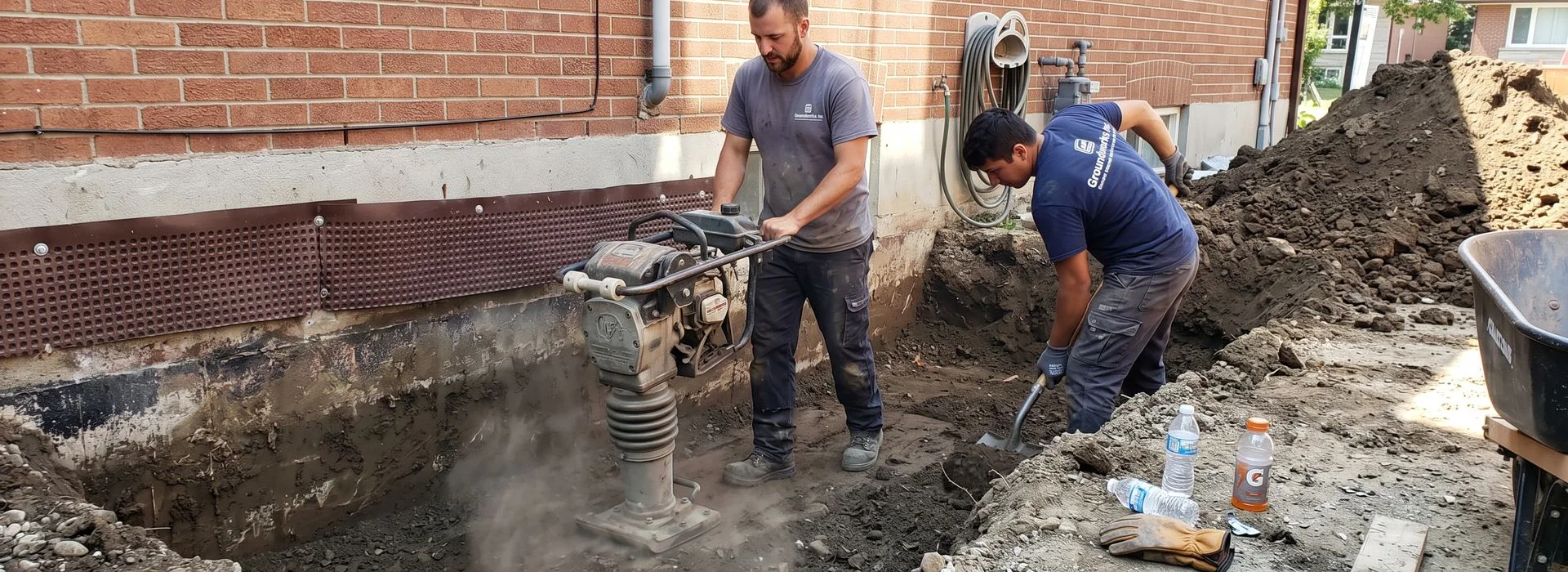
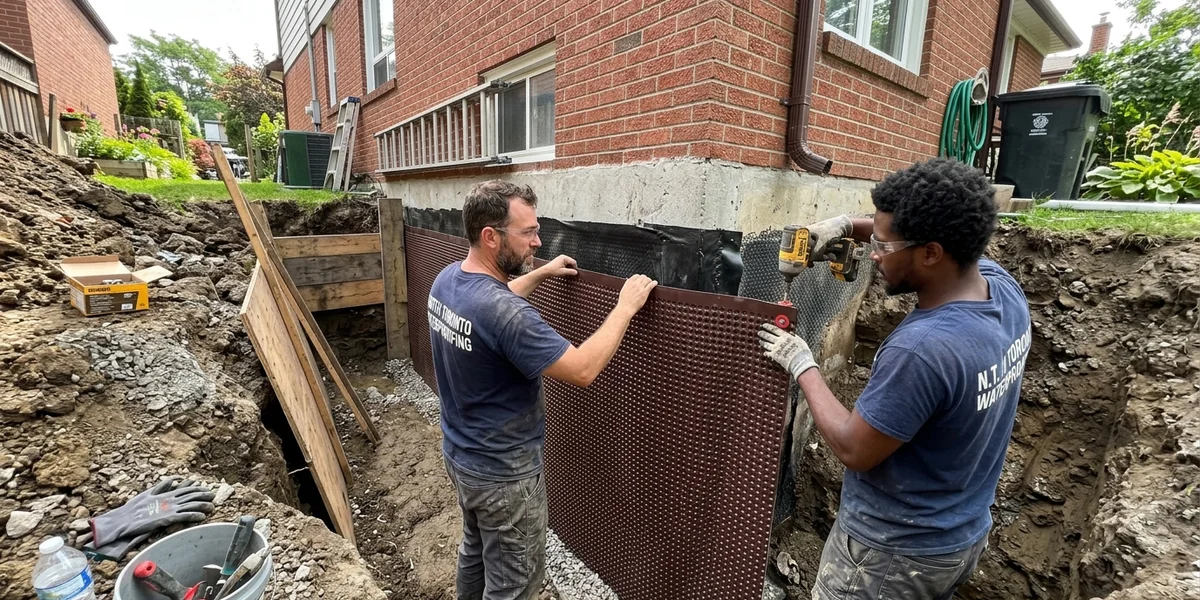
Exterior weeping tile installation by Foundation Waterproofing Toronto rebuilds the drainage system your house was supposed to have. We excavate to footing level, remove the failed footing tile, clean and repair the wall face, apply an elastomeric rubberized asphalt membrane, fasten dimpled drainage board over it, and lay new perforated pipe in 3/4 inch clear washed crushed stone wrapped in non-woven geotextile filter cloth. Backfill goes back in compacted lifts and the grade is restored so surface water runs away from the house, relieving hydrostatic pressure before it ever reaches the basement wall.
The reason this is the most durable approach is simple: the wall assembly stays dry. Interior weeping tile is excellent at relieving pressure under the slab, but water still reaches the concrete or block before it is collected. Exterior work stops it in the soil. It is also a different job from a French drain, which sits higher in the yard and intercepts surface water before it reaches the foundation, while weeping tile sits at the footing and drains the foundation itself.
Membrane, Drainage Board and Pipe: The Layers From the Wall Outward
Wall preparation. Loose material is removed, spalled concrete is repaired, and irregular surfaces get hydraulic cement parging so the membrane has a continuous substrate to bond to. Membrane over an unprepared wall is the single most common exterior failure the Foundation Waterproofing Toronto crew is called to correct. Where the wall needs more than surface patching, it moves into concrete foundation repair before any membrane goes on.
Membrane. A self-adhered or trowel-applied waterproofing layer. We work with Blueskin WP 200 and Aqua Bloc systems, chosen to match the substrate and the season, installed to the manufacturer specification the warranty depends on.
Drainage board. Delta-MS drainage board or Platon dimpled sheet is fastened over the membrane with a termination bar at grade level. The dimples hold soil off the membrane and give any water a vertical path down to the pipe.
Pipe and stone. Perforated pipe sits beside the footing in clear washed stone, with filter cloth over the stone so silt never reaches the perforations. That detail is exactly what the original clay tile lacked. Where the lot has no positive outlet for the new line, sump pump installation is scoped alongside the trench, and the Toronto Basement Flooding Protection Subsidy can offset up to $1,750 CAD of the pump.
Backfill. Placed in lifts, mechanically tamped, then graded to a positive slope away from the wall.
Which Excavation Scope Does Your Foundation Need?
These are 2026 CAD bands and match the price tiers further down the page.
| Scope | Cost in Toronto | When it applies |
|---|---|---|
| Single wall | $4,500 to $12,000 CAD | One wall with lawn or soft landscaping above it, excavated to footing level |
| Two walls or a corner | $9,000 to $19,000 CAD | Water enters along a corner, usually the low side of the lot |
| Full perimeter | $15,000 to $35,000 CAD | Complete excavation with new weeping tile and membrane all the way round |
| Combined with interior drainage | $20,000 to $45,000 CAD | One side of the house cannot be excavated and the rest can |
Why Original Clay Footing Tile Fails in Older Toronto Homes
Homes built here before the early 1970s, from the detached houses of Leaside and East York to the older semis of The Beaches, were drained with short sections of unglazed clay tile laid end to end with open joints. Water entered through the joints, which worked until the joints did what open joints do: admit silt, shift with freeze-thaw cycling at a frost line depth 1.2 metres above the footing, and invite tree roots from mature street trees. Once a section crushes or plugs, the water that used to leave the footing zone sits there instead, and hydrostatic pressure starts pushing at the cove joint and any crack it can find.
A camera scope of the existing line during the inspection tells us whether the tile is still open, partially silted, or gone. That single test is what decides between crack repair, interior drainage, and full exterior replacement.
Exterior or Interior Drainage: When Excavation Is Worth It
Exterior costs more than interior in almost every case, so it needs a reason:
- The wall face itself needs repair, parging, or crack sealing that can only be done from outside.
- Water enters high on the wall, above the level a sub-slab channel would ever intercept.
- The basement was recently finished and opening the slab would cost more in restoration than trenching outside.
- A camera scope confirms the exterior line has failed and the lot has practical excavation access, which is common on the wider postwar bungalow lots of North York and Scarborough.
- Landscaping is being redone anyway, which collapses the reinstatement cost into work you were already funding.
Where none of those apply, interior weeping tile at $8,000 to $18,000 CAD does the same job for the homeowner at lower cost and lower disruption, and our written diagnostic will say so.
How We Compare
| What you get | Typical provider | Foundation Waterproofing Toronto |
|---|---|---|
| Pricing | Quoted only after a site visit | $4,500 to $35,000 CAD bands published on this page (2026 pricing) |
| Existing tile assessment | Full replacement assumed | Camera scope of the old line before any digging is quoted |
| Reinstatement | Buried in a lump sum | Landscaping and hardscape quoted as its own line |
| Permits | Left to the homeowner | City of Toronto Building Division permit filed, inspected, and closed out |
| Backfill | Dumped and raked | Placed in lifts and mechanically tamped, graded away from the wall |
| Track record | Unstated | 25+ years, WSIB registered, $2M liability insurance |
What to Expect While the Trench Is Open
Expect a working excavation for most of the project. We stage the dig so only the section under active work is open, keep spoil either on site or hauled depending on lot size, and protect walkways and driveways on the machine route. Utilities are located through Ontario One Call before the first bucket. Shoring goes in wherever depth and soil conditions require it, which in Toronto clay is most of the time below two metres, and on the tight side yards between semi-detached homes in Leslieville the narrowest sections are dug by hand.
Weather governs the schedule. Membrane needs a dry, properly prepared substrate, and backfilling over an uncured membrane is how a ten-year system becomes a two-year system. If the forecast forces a pause, the trench is secured and we resume.
Getting Your Yard Back: Landscaping and Hardscape Reinstatement
Everything above the trench line comes out. Sod, garden beds, shrubs, interlock pavers, walkways, sometimes a section of deck. We quote removal and reinstatement as its own line item so the number is visible, and we tell you honestly where reinstatement is better handled by your landscaper after the fact.
If you are planning exterior waterproofing, book the free in-home inspection first. The camera scope, the access assessment, and the written CAD comparison against an interior system all happen before you spend anything, the same way we scope every foundation waterproofing Toronto project.